Changing a Voice in Real Time Without Speech Recognition
Changing a Voice in Real Time Without Speech Recognition
A real-time voice changer sounds like it ought to involve understanding speech. It does not, and the fact that it does not is the most useful thing about it.
It is signal processing. It operates on the waveform, not on words, which means it behaves identically whether the person is speaking English, Tamil, Hindi, Telugu or nothing in particular. There is no language setting because there is no language model.
Pitch is not the whole job
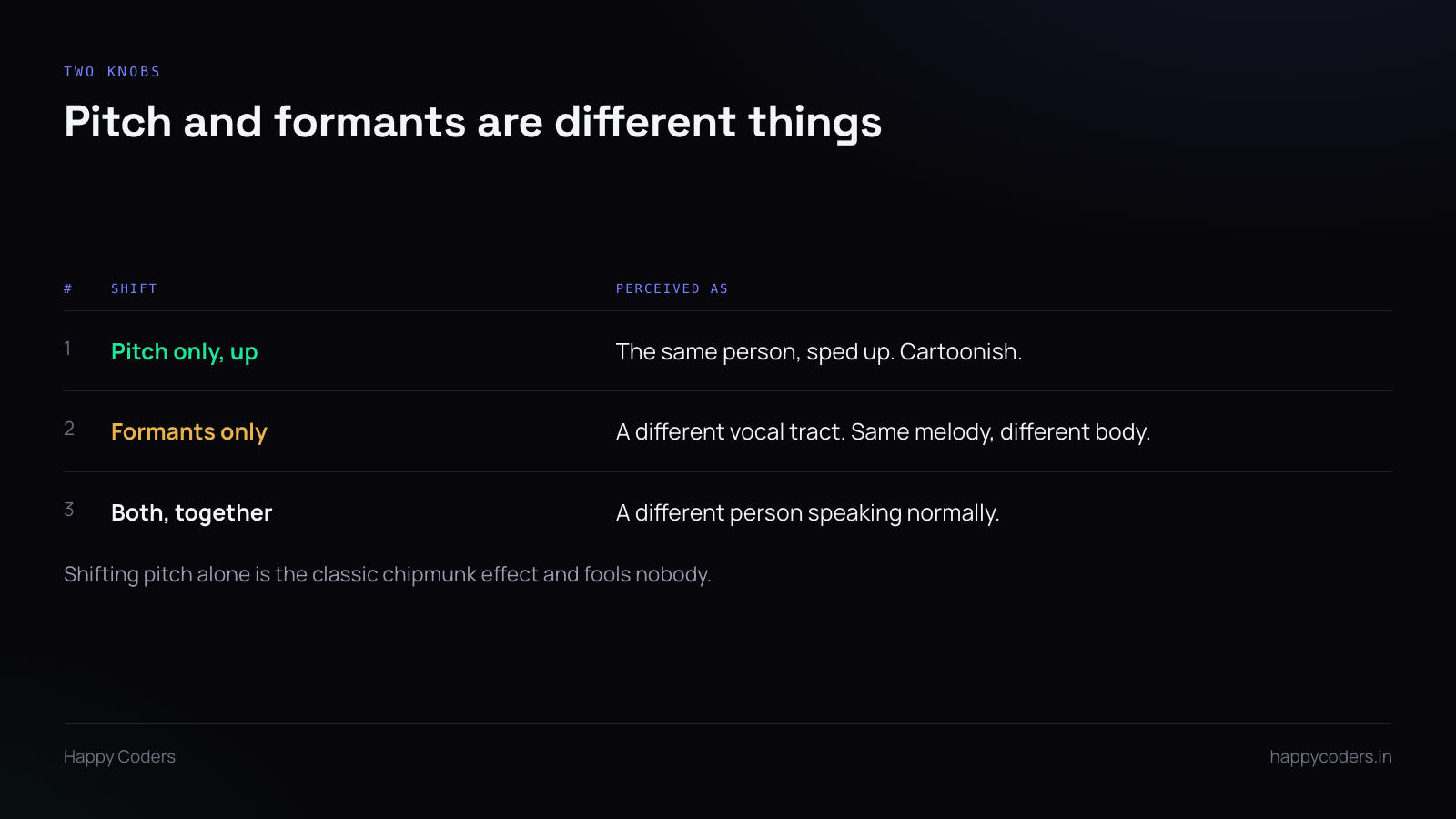
The obvious approach — speed the signal up to raise the pitch — produces the chipmunk effect, and the reason it is unconvincing is that it moves two things at once that should move independently.
Pitch is the fundamental frequency, the rate at which the vocal folds vibrate. It is the melody of a voice.
Formants are resonances of the vocal tract — the shape of your throat and mouth. They are why two people singing exactly the same note still sound like two people. A longer vocal tract produces lower formants, which is most of what you are hearing when you hear “a deeper voice” rather than “a lower note”.
Shift the pitch alone and you get the same person sped up. Shift the formants alone and you get a different body singing the same melody, which is strange but not comical. Shift both, in a controlled relationship, and you get what sounds like a different person speaking normally.
How it is done without changing the speed
Pitch shifting that does not change duration is the whole trick, and the standard approach is a phase vocoder or an overlap-add scheme.
Take a short window of audio. Analyse it into frequency components. Shift those components. Resynthesise, overlapping with the neighbouring windows so the result is continuous.
The quality problem is phase. Shifting magnitude is easy; keeping the phase relationships coherent between overlapping windows is what separates a clean result from one that sounds metallic and smeared. Most of the engineering in a good pitch shifter is phase handling.
Formant shifting is a separate operation applied to the spectral envelope — the shape of the spectrum rather than the individual components. Done properly, you can move formants without touching pitch, and that independence is what the presets are built from.
The latency budget
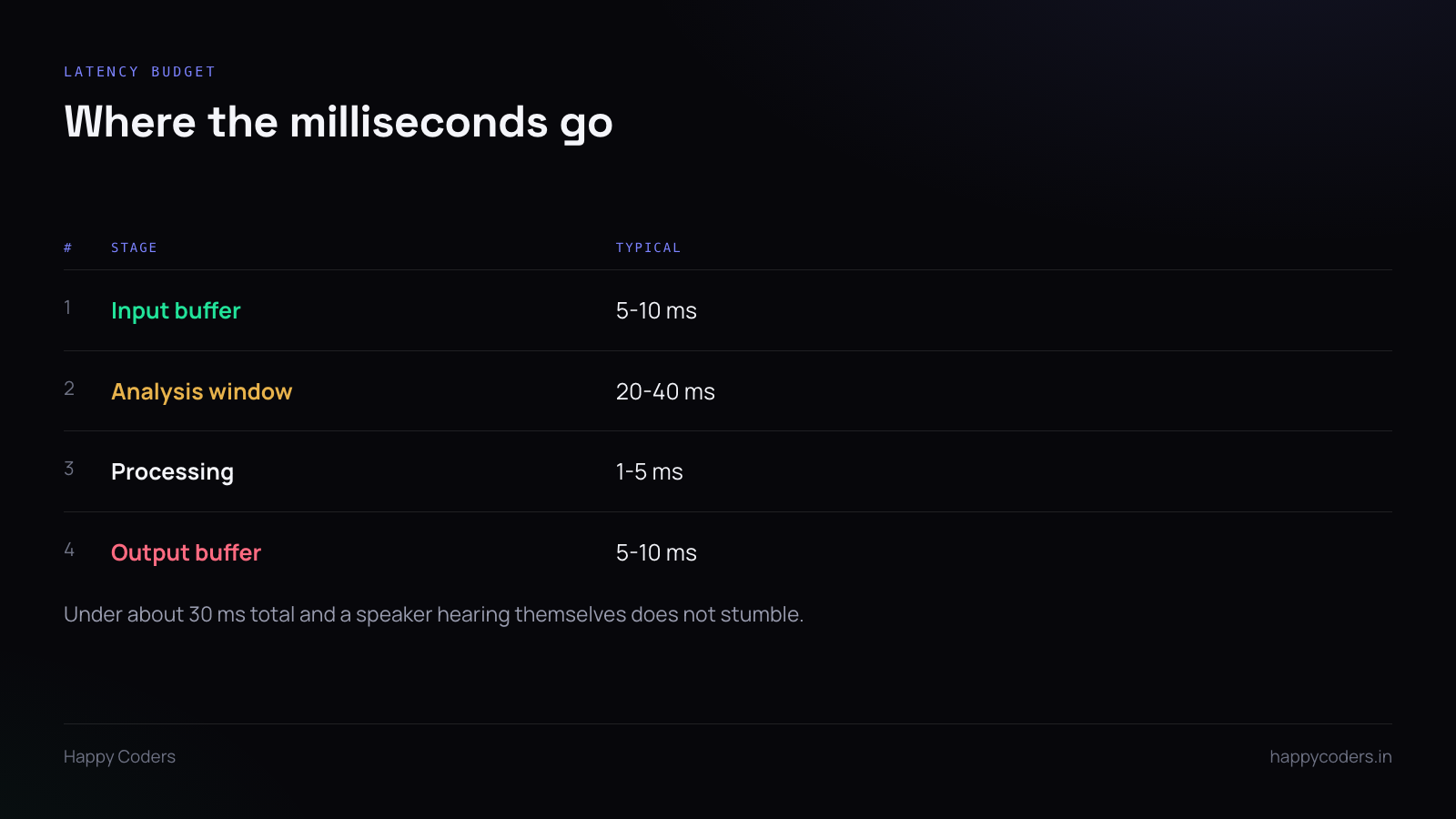
Real-time has a hard requirement that offline processing does not: the speaker hears their own voice.
If the delay between speaking and hearing exceeds roughly thirty milliseconds, people start to stumble over their own words. It is an involuntary response and it does not improve with practice. So the whole pipeline — input buffer, analysis window, processing, output buffer — has to fit in that budget.
The tension is that a longer analysis window gives better frequency resolution and therefore better quality. You are trading audio quality against the speaker’s ability to talk. Twenty to forty milliseconds of window is the usual compromise, with the rest of the budget kept as small as the audio hardware allows.
If the speaker is monitoring through headphones, the budget is strict. If they are not hearing themselves processed at all, it relaxes considerably — which is worth knowing, because it means the recording path and the monitoring path can have different settings.
Why language independence follows
This is the part worth stating plainly, because users ask.
The processor never identifies a phoneme, never segments a word, never consults a dictionary. It sees a waveform, decomposes it, moves frequencies, and puts it back. A Tamil vowel and an English vowel are both just energy at frequencies, and shifting those frequencies does the same thing to both.
The practical consequence: there is no language dropdown, no model to download per language, and no degraded behaviour for languages that happen not to be well represented in a training set. For a tool used in India that is not a small thing — most speech-based features behave noticeably worse in Tamil than in English, and this category of feature simply does not have the problem.
It also means no transcription is produced, which is a privacy property. There is no text anywhere, because the system never computed any.
Where it falls down
Extreme shifts. Small shifts sound natural. Large ones sound processed, because the phase handling cannot keep up and the formant envelope stops being plausible for any real vocal tract. Presets exist partly to keep users inside the range where it still sounds like a person.
Background noise. The processor shifts everything, including the fan and the room. Noise that was unobtrusive at its original frequency can become obvious when moved. A close microphone helps more than any setting.
Breaths and plosives. Non-periodic sounds have no pitch to shift and can come out sounding odd. Good implementations detect and handle them separately.
Platform differences are normal
Worth saying, because users compare: a voice changer built natively on one platform and ported to another often has a different set of presets, and that is usually honest rather than lazy. The effects that depend on deeper platform audio features exist where those features do; the core pitch and formant shift travels everywhere.
Listing which presets exist on which platform is better than implying they all do. The person who downloads it for a specific effect will find out within a minute either way.